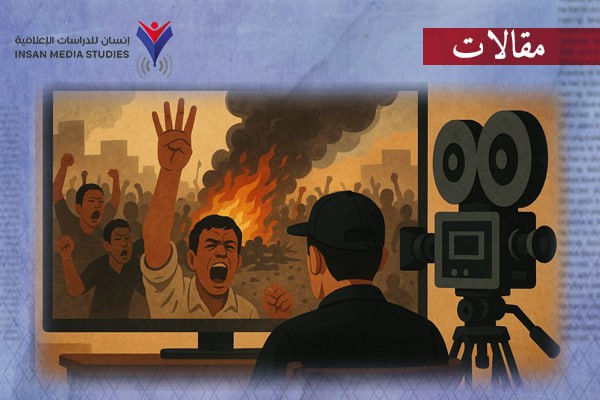
From the Square to the Screen… How Did the Egyptian Drama Depict the Rabaa al-Adawiya Massacre?!
Hanan Atya
Twelve years after the Rabaa al-Adawiya massacre, the memory remains etched in the Egyptian collective consciousness as an unhealed wound and a silent witness to a deep rift between reality and art. Just as judicial justice failed to hold the perpetrators accountable, artistic justice has failed to present a narrative worthy of the magnitude of the event and its impact on Egyptian society.
The disappearance of “Rabaa” from the Egyptian artistic scene was not a mere coincidence or a natural result of changing audience interests. Rather, it was part of a systematic strategy aimed at reshaping collective consciousness and erasing everything that does not align with the narrative of the tyrants, who wanted their version to take root in minds.
In any society undergoing an existential crisis—like the one Egypt experienced in 2013—art is supposed to be a mirror reflecting trauma, helping people understand what happened, and offering a space for dialogue and healing. However, what took place in Egypt was precisely the opposite: artistic production was turned into a workshop to consolidate a single narrative—the narrative of the victorious killer—while the victims were erased from the collective memory.
This was not limited to a media blackout; it extended to the art industry itself. Dramatic and cinematic works became tools to justify violence and falsify facts. If we were to review the artistic works that addressed the events of Rabaa al-Adawiya—whether explicitly or symbolically—we would find them extremely rare, barely counting on the fingers of one hand.
These works—few as they are—either adopted the coup’s narrative, which portrays the massacre as a “confrontation with terrorism,” or resorted to vague symbolism for fear of bans and confiscations. Even symbolic attempts were not spared from censorship, as happened with the film Bekia (2021), which faced unannounced hurdles due to its allusions to security corruption, or the series Autumn, which was aborted before airing because it approached the theme of the Arab Spring.
Writing History Through Fake Art
The cruelest paradox is not merely the ban on critical works, but the production of parallel artistic works that rewrite history in a distorted manner. While scenes of political arrest or repression are edited out of films and series—as occurred in the film I Love You (2017)—we witness the production of works like the series The Choice (2020), which presents the security apparatuses’ narrative as indisputable truth.
Here, the issue goes beyond stripping art of any dissenting voice; the void is filled with an alternative narrative that legitimizes violence and holds victims responsible for their own deaths. Thus, we face a double crime: the erasure of memory and its replacement with a forged narrative serving the coup regime.
Silencing Courageous Attempts
The very few works that dared to approach the red line did not originate from within the traditional artistic establishment, but rather from its margins or completely outside Egypt. Among them, for instance, is the film Yomeddine (2018) by Mahmoud Hamdy, which was forced to use excessive symbolism and shoot outside Egypt to avoid confiscation.
As for foreign works that addressed Rabaa—such as the documentary Rabaa (2018) or the Turkish series The Trench (2020)—the coup regime portrayed them as “part of a foreign conspiracy against Egypt,” leading to their ban and vilification.
This shift transformed art into an existential battlefield, where any work not serving the coup narrative became a threat to be neutralized. Fear was no longer confined to direct censorship; it evolved into self-censorship practiced by artists themselves due to the coup regime’s control over production companies and broadcast channels. Creators no longer needed direct instructions to know what was permitted and what was forbidden.
The Historical Mistake of Tyrants
Yet, the historical mistake tyrants repeat is believing they can erase collective memory so easily. The regime may succeed in preventing the memory of “Rabaa” from appearing on screens, but it will never be able to erase it from the minds and hearts of those who lived through those events, or from the memories of families who lost loved ones. The blood spilled in the square will not be washed away by the silence of art, nor will it be forgotten by history.
Today, as the regime continues to impose its narrative, the question remains: How long will this silence endure? And when will Egyptian art have the courage to reflect the full truth, rather than remaining a mere tool in the hands of oppressive power?
Inevitably, the day will come when the archives are opened, stories are told as they truly happened, and dignity is restored to the victims. Until then, Rabaa al-Adawiya will remain an open wound on the nation’s conscience and a witness to the fact that art which betrays the truth is not art at all, but merely propaganda.