Truth Guardians in the Eye of the Storm… Who Protects the Right to Knowledge Amidst the Escalating Targeting of Journalists?
At the “Insan Media Center” Symposium on World Press Freedom Day:
- Mai El-Wardany: Journalism is a human necessity and not a luxury… and the struggle continues to convey the truth.
- Dr. Mustafa Özdemir: The encroachment of digital and security threats requires a real activation of international frameworks to protect journalists.
- Aisha Mzein: Targeting the families of journalists and bombing their homes in Gaza and Lebanon will not deter us from our approach to break the siege.
- Abdul Jawad Mustafa: East Turkestan has turned into the largest laboratory for human oppression and the erasure of religious identity.
- Fatima Ar: China tops the list of journalists’ jailers and imposes an information blockade to silence witnesses.
“Insan Media” – Editorial Team:
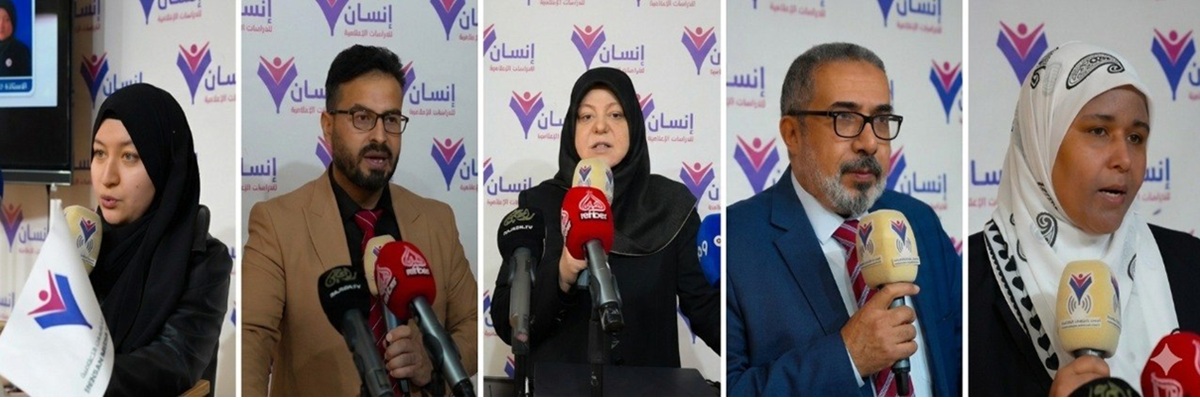
Participants in the “Who Protects the Right to Knowledge” symposium—organized by the Insan Center for Media Studies in Istanbul on Tuesday, May 5, 2026, on the occasion of World Press Freedom Day—emphasized that journalism has become an “absolute necessity and not a luxury,” and that the right to knowledge represents the fundamental pillar that enables peoples to determine their own destiny and confront tyranny.
Attendees stressed that protecting this right requires urgent international solidarity, especially after journalistic work turned into a heavy blood tax that is no longer limited to journalists alone, but has extended to their families by targeting their homes in conflict zones.
They explained that patterns of repression have evolved dangerously; they are no longer limited to physical risks such as arrest and assassination, but have come to include the creation of “smart prisons” and a systematic information blockade managed by artificial intelligence techniques, digital surveillance, and defamation to undermine credibility.
Reviewing the reality of on-the-ground repression, the symposium revealed the killing of approximately 365 journalists in Gaza and Lebanon over two years of coverage. Meanwhile, East Turkestan was described as having turned into the “largest laboratory for human oppression,” now media-isolated under strict censorship aimed at erasing identity and suppressing the truth.
The participants also warned against the dangerous deterioration of freedoms in Egypt, which is now internationally classified within the “black zone” as a result of the expansion of “repressive legislation” and the disappearance of hundreds of writers behind bars.
The participants agreed that the right to knowledge is an inherent human right stipulated by international charters, and protecting it is a moral responsibility borne by the entire international community.
They confirmed that exploiting laws and political interests to overlook violations fuels injustice. They considered that breaking the information blockade and achieving justice in Palestine represents the common path and the necessary entry point for the liberation of all oppressed peoples around the world.
The Right to Knowledge Needs to Be Defended
At the beginning of the symposium, Mai El-Wardany, Director of the Insan Center for Media Studies, confirmed that journalism is a “necessity and not a luxury,” and that the right to knowledge needs someone to defend it amidst turbulent waves of restrictions on press freedom and the targeting of journalists globally.
She added:
“In our region in particular, we are still struggling to prove that journalism is not a crime, after the targeting of journalists turned into a daily ritual in front of an international audience that does not lift a finger.”
She pointed to a previous symposium organized by the center to discuss various aspects of press freedom with the participation of colleagues from Palestine, Yemen, Syria, Egypt, and the Arab Maghreb.
She stated:
“Before that, our voices rose during the events of ‘Al-Aqsa Flood’ to demand the rights of our Palestinian journalist colleagues, and we demanded that this day be ‘Palestinian Journalist Day’ to commemorate their blood that watered the fountain of truth.”
Contemporary Threats to Journalists and Legal Protection
For his part, Dr. Mustafa Özdemir, a specialist in Public International Law, reviewed his research paper titled: “The Escalating Threats to the Safety of Journalists and the Legal Protection of Their Rights as Professional Employees,” which addressed the “labor law in the journalism sector” and the global threats they face.
He pointed out that threats are no longer limited to conflict zones, but have become a global phenomenon with various patterns, including:
- Physical Threats: Journalists face the most dangerous forms of threat, especially in conflict zones, and are subjected to targeting and assassination because of their work or investigations. Physical threats also include detention, kidnapping, taking hostages, and arbitrary arrest to silence voices, in addition to physical assaults while covering events.
- Digital and Legal Threats: These include hacking, communication espionage, device breaches, and organized defamation campaigns to undermine credibility, as well as interference through internet blocking and cyber-attacks.
- Legal Overreach: Anti-terrorism and national security laws are exploited to restrict press freedom and prevent access to information, which pushes journalists to “self-censorship” to avoid risks, negatively affecting the quality of the truth being conveyed.
Özdemir reviewed the international legal frameworks for protecting journalists, such as the Universal Declaration of Human Rights and the Geneva Conventions, which emphasize that journalists are considered civilians who must be protected. In conclusion, he stressed the need to strengthen legislation to prevent the exploitation of laws for repression, and to support joint initiatives between media institutions and civil society to provide legal, professional, and psychological support for journalists.
The Steadfastness of Gaza and the Responsibility to Break the Siege
The activist and media personality, Aisha Mzein, began her speech by thanking everyone who contributed and participated in delivering the voice of the oppressed. She appreciated the role of journalists who attempt to convey the truth despite the difficult circumstances, pointing to the history of “Israel’s” occupation of the Palestinian territories since 1948 and the continuation of its policies with all its cruelty—a reality extending from that date until today.
She pointed to the steadfastness of the Palestinian people and their adherence to their rights and land, despite the presence of parties that seek to justify illegal violations and force Israel’s control over the occupied territories.
She added:
“Journalists were not the only ones in the circle of danger; their families were also targeted. Homes are bombed, neighborhoods are destroyed, and places of refuge in conflict zones are targeted, making journalistic work in these circumstances extremely dangerous.”
She stated that over the past two years, a large number of journalists have been killed in Gaza and Lebanon while performing their duties, estimated at about 365 journalists in the context of field coverage.
“We, as civilians, volunteers, and journalists, seek to maintain the continuity of conveying the truth, supporting peoples affected by conflicts, and keeping their voice present in global public opinion.”
Mzein attributed Israel’s focus on taking revenge on the Palestinian people to its failure to achieve its alleged project—referring to the “Greater Israel” project, through which the Israeli occupation plans to expand its state and extend it across the region. However, the current political reality did not realize these perceptions for them.
She pointed to the reality of Gaza and the blockade imposed on it as a narrow coastal area, which led to its significant isolation from the outside world and pushed its population into extremely difficult living conditions, despite attempts to communicate through various means. She explained that to bring this issue to the world, multiple sea voyages and humanitarian initiatives were organized. The most prominent was in 2010 via a fleet that set off from Istanbul towards Gaza with the participation of hundreds of activists from various countries and diverse religious and cultural backgrounds. The goal was to deliver humanitarian aid on one hand, and to shed light on the humanitarian situation and the blockade on the other.
She continued that there are recent international movements involving activists from dozens of countries, including European and Arab nations, as part of multiple maritime humanitarian initiatives. Despite the expectation that some of these voyages might be intercepted, the participants affirm their continuation of this peaceful approach, whether by sea or land, with the aim of breaking the siege on Gaza and delivering their voice to the international community.
She emphasized that delivering the voice of the victims and affected civilians and supporting humanitarian causes represents a moral and humanitarian responsibility. She noted that solving the crises of oppressed peoples is linked to achieving justice and peace, and that the liberation of all oppressed regions and peoples in the world has one common path, the knot of which will be untied in Palestine: when Palestine is liberated, the entire world will be liberated.
East Turkestan… The Largest Laboratory for Human Oppression
In his speech at the symposium, media professional Abdul Jawad Mustafa, Head of the Arabic Section at the “East Turkestan News Agency,” pointed out that on World Press Freedom Day—a day on which the word should be sanctified and the truth revealed—we stand with hearts full of sorrow in front of a spot-on earth that was intended to be erased from the memory of existence.
He said:
“Today we are not talking about a political conflict; we are talking about ‘East Turkestan’, the land that has turned into the largest laboratory of human oppression in modern history, where China swallows the truth and confiscates speech to pass a crime of silent genocide, while promoting its false narrative that polishes its serious violations.”
He referred to statistics based on United Nations estimates, which indicate the detention of between one to three million Uyghur Muslims in camps falsely called “training centers” or “rehabilitation centers.” In reality, they are detention centers used to oppress human beings and erase their religious, cultural, and ethnic identity. They are smart prisons managed by algorithms, where detainees are forced for long hours to renounce their identity, culture, history, and religion, and are forcefully made to consume forbidden items under the threat of torture and abuse.
He also pointed to the suffering of the Uyghur children known as “living orphans,” with more than half a million children separated from their detained families and placed in closed boarding schools, as part of policies aimed at erasing their religious and cultural identity and alienating them from their language and history.
He clarified that China’s repressive policies affected religious sites, with thousands of mosques demolished or repurposed in the context of restricting religious practices. This was not all; expressing religious identity, such as using Islamic greetings, possessing the Holy Quran, or performing rituals, has become a reason for prosecution and arrest under security pretexts.
The Information Blockade and the Disappearance of Witnesses in Turkestan
Activist Fatima Ar, from East Turkestan, spoke about a dangerous escalation in attempts to silence witnesses, emphasizing that East Turkestan is experiencing a systematic information blockade. It has been transformed into a media-isolated region subject to strict censorship that controls the flow of information to journalists and civilians.
She stated:
“Advanced digital tools, including artificial intelligence, are used to monitor content and track journalists, alongside a broad blocking of websites and the closure of cultural and media platforms, which has led to the obliteration of cultural identity.”
She added:
“Journalists and intellectuals suffer from arrest and intimidation, as China is considered one of the largest countries in the world in imprisoning journalists, with specific targeting of the Uyghurs. In addition, there are restrictions on international media, pushing media institutions to withdraw. Conversely, misleading official narratives are promoted through state-directed media tools to cover up the violations.”
She concluded with an urgent call to the international community, governments, media institutions, and civil society organizations to take action to break the media blockade, defend press freedom, support journalists, and not allow political and economic interests to overlook human rights violations, emphasizing that silence contributes to the continuation of injustice.
The Reality of the Egyptian Press and the “Black Zone”
At the end of the symposium, Mai El-Wardany thanked the participants for their attendance and recalled the Egyptian journalistic situation, where the lives of journalists seeking the truth are being wasted under the weight of “repressive legislation,” continuous restrictions on freedoms, and the withholding of information, which is a fundamental right of citizens.
She said:
“There are hundreds of writers, photographers, and cartoonists in the cells, among whom we mention—for example—our colleagues: Mohsen Rady, Badr Mohammed Badr, Ahmed Subaie, Yasser Abu Al-Ela, Ashraf Omar, and Safaa El-Korbiji… and the list is long with knights of the word for whom we await the dawn of their freedom.”
She added:
“When these knights were absent, the remaining fraction of press freedom was absent with them, and the light of knowledge was extinguished across Egypt after the regime tightened its grip on the media and drama production studios. Consequently, Egypt is now classified in international reports within the ‘black zone’ as one of the countries that imprisons the most journalists in the world and restricts their freedoms.”