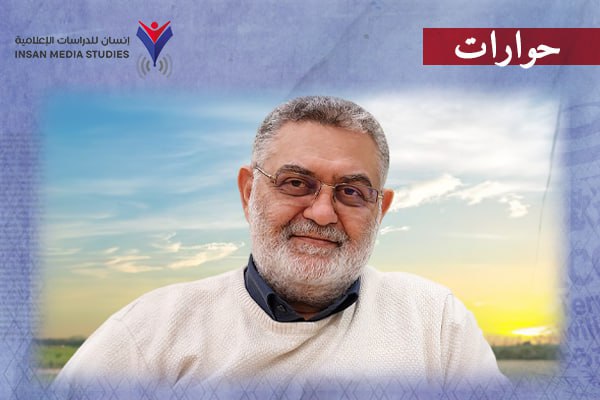
Ahmed Abdel Aziz: Freedom of Expression Was the Most Prominent Gain of President Morsi’s Rule
Member of Morsi’s Presidential Team and Official in Charge of the Radio and Television Union File:
- Creating the “Maspero File” within the presidency stemmed from President Morsi’s realization of the media’s importance and seriousness.
- The “Diwan of Grievances” program was set to open a free, direct way between the masses and the President without mediation.
- We attempted to regulate the language and terminology of the official media, and we suspended programs and figures working for the counter-revolution.
- All my efforts were focused on extinguishing fires within the official media and rebuilding it on professional and national foundations.
- Practicing the media profession without a sound creed, governing ethics, and political awareness is considered “corruption on Earth.”
Insan for Media – Interview by: Mai Al-Wardani
During the year of the rule of Egypt’s martyred President, Mohamed Morsi, the media was a daily battlefield and a frontline of confrontation between the revolution and the deep state.
Alongside the clashes involving official and private media, there was the narrative of the presidential palace itself from the inside. This was documented by Ahmed Abdel Aziz, a member of the presidential team for the martyred President and the official in charge of the Maspero file at the Presidency of the Republic of Egypt, in his book “6 Months in Maspero.”
Nevertheless, questions continue to be raised until today: Why was the presidential media not on par with the scale of the challenges? Why was the official narrative absent or deficient, especially during times of crisis? Could the media have altered the fate of Morsi’s experiment had it been managed better?
In our quest to obtain answers to these questions and others raised about the management of the presidency’s media file during President Morsi’s era, we conducted this exclusive interview with Ahmed Abdel Aziz. As a member of the presidential team, the official in charge of the Maspero file, and one of the most prominent witnesses to the media landscape at that time, he asserted that the most important gain of all achieved during President Morsi’s era was “freedom of expression.” He noted that neither citizens nor the media had ever enjoyed such freedom from 1952 until 2013.
He stressed that President Morsi—may God have mercy on him—fully realized the importance and gravity of the media. Consequently, the “Maspero File” was created within the presidency to correct the course of this sensitive national apparatus.
He pointed out that within a short period, he managed to introduce radical changes to the official media by canceling programs, suspending presenters speaking on behalf of the counter-revolution, and introducing media initiatives such as the “Diwan of Grievances” program. This program, which never saw the light of day due to the coup, would have formed a direct bridge between the citizen and the President.
He emphasized that the official media witnessed real success in breaking the deep state’s monopoly, even if temporarily, whereas private media remained a tool in the hands of the counter-revolution.
He considered that the post-2013 media is no longer media in the professional sense, but rather a tool for suppression, noting that President Morsi’s period was a rare exception in Egypt’s history.
He concluded his remarks with advice directed at young media professionals, calling on them to ground themselves ethically, ideologically, and politically before gaining professional mastery, because media without awareness is “corruption on Earth,” as he put it.
Text of the Interview:
To begin with… How would you describe the experience of working within the Media Office of the Presidency of the Republic?
It was an experience that confirmed to me that whoever holds authority can do anything. This authority does not necessarily have to be derived from a job title or a position in the hierarchy of power. My personal experience proved that employees across the institution, at various levels and positions, were fully prepared to bestow traits and titles upon an official that did not actually exist!
I remember that on my very first visit to the Radio and Television Union (Maspero), my colleagues in the presidential media surprised me the next day with a newspaper clipping carrying the headline: “The President’s Advisor for News Visits Maspero!” Where did they get this title, “The President’s Advisor for News”? And who was the one who coined it? I do not know.
As for my explanation, it is because one of the issues I discussed with the head of the Union was the issue of “regulating news language and political terminology,” which was suffering from clear distortion in its political connotations!
For example: the term “civil and Islamic forces”… This term, in its essence, denies the attribute of “civilianness” to Islamists. We should either say: “secular and Islamic forces,” clearly so, because Islam is the opposite of secularism, not civilianism; or we should say: “national forces of various orientations,” because everyone is nationalistic, and this is the language required to promote civil peace. It was illogical to adopt the first term because it implies “excommunicating” (Takfir) secularists, which was not appropriate at the time.
What were the most prominent challenges you faced in communicating with official and private media outlets?
Personally, thanks first to Allah, and then to methodical, professional dialogue, I was able to do everything I wanted . I canceled a program that was about to be launched (by Mohamed Al-Gheiti), suspended a program that was being broadcast during prime time, and terminated the contract of Mohamed Ali Khair—one of the mouthpieces of the counter-revolution. Later, I allowed him to work at Radio 9090 under strict professional conditions so he could support his family. All of this was done legally and for professional reasons, not partisan, personal, or vindictive ones.
I also commenced the launch of programs that, had they been destined to continue, would have changed the situation in Egypt. Among them was the “Diwan of Grievances” program, following an unarranged meeting over lunch at the presidency with the head of the Diwan of Grievances, Mr. Mostafa Al-Sharbatly. The goal of this program was to provide an opportunity for direct communication between the masses and the Presidency of the Republic, to solve their problems, and to inform the President directly (without mediation or reports) of people’s issues and sufferings, while highlighting both negligent and dedicated individuals alike. However, the coup was faster, and the program never saw the light of day.
As for the private media, it did not fall within my jurisdiction; it fell under the responsibilities of the Minister of Investment. The colleague handling its file at the presidency was Dr. Sameh Al-Eissawy—may God heal him. This is something the general public does not know.
How did President Morsi view the media? Did he follow the performance of the presidential media himself?
President Morsi (may God have mercy on him) fully realized the importance and gravity of the media. Naturally, he followed the media file by virtue of his responsibility for all files. The “Maspero File” was created within the presidency to correct the course of this sensitive national apparatus, and I was assigned this responsibility in January 2013. I recorded this experience in my book “6 Months in Maspero.”
From your point of view, what were the most prominent gains achieved in the media file during President Morsi’s rule?
The most important gain of all achieved during President Morsi’s era was “freedom of expression.” Neither citizens nor the media had ever enjoyed such freedom from 1952 until 2013. It should be noted that this freedom during the era of the Military Council (after January 25, 2011) was “wrested” away by society; freedom of expression used to cause annoyance and headaches for the ruling Military Council. However, during President Morsi’s era, “freedom of expression” was part of the social contract between the new authority and society, its individuals, and institutions, implementing the articles of the constitution approved by the people by a 65% majority.
When I was a media advisor to the Constituent Assembly for drafting the constitution, I launched a daily live program titled “The Constitution in the Balance,” weeks before the constitution was put to a popular vote. It was broadcast from one of the halls of the Shura Council (the headquarters of the Constituent Assembly at the time).
The program was an open forum for discussion about the constitution—its advantages, disadvantages, and what should be amended or added. There were no restrictions of any kind on participation in the program; the opportunity was available to any citizen to participate and ask questions live on air. All that was required was to register one’s name on the program’s Facebook page to facilitate entry through the Shura Council gate. Four guests sat on the podium: two professors of constitutional jurisprudence and two members of the Constituent Assembly to answer the public’s questions. Three presenters from the official television took turns hosting the program.
Why was a media narrative about President Morsi’s achievements not built, even among his supporters?
State media addresses all Egyptians: supporters, opponents, and bystanders. Upon assuming responsibility for the “Maspero File” at the presidency, I contacted Ambassador Alaa El-Hadidi, the media spokesperson for the Prime Ministry. I visited him in his office and agreed with him on a specific mechanism to inform me of the ministers’ activities and achievements so they could be covered in the official media. However, he did not implement the agreement!
How do you view the state of media freedoms in Egypt after 2013 compared to Morsi’s governance period?
There is no longer any media in Egypt for us to talk about its freedom or its silencing! President Morsi’s period was a very short parenthesis in the massive “Book of Oppression” that Egyptians have known exclusively for long centuries.
Did you communicate with prominent media figures to cover presidential news? What was the level of acceptance or rejection you faced?
Official television and other local and foreign media outlets have correspondents at the presidency to cover the President’s news routinely. As for interviews, the presidency fulfilled requests from a number of entities wishing to conduct interviews with the President.
Was there internal resistance within the official media against any attempt at reform or renewal of the discourse?
Of course, that existed. I remember that I confronted everything I monitored in that regard during my period of responsibility over the “Maspero File,” and I succeeded immensely, thank God. It is important to note that the state-funded press was not within my jurisdiction.
Why was the institution of the presidency unable to break the deep state’s monopoly over official media, especially Maspero?
On the contrary, it did break it. It imposed its “national agenda” and achieved great success in doing so, to the extent that it forced the deep state or the counter-revolution into dormancy. In this regard, my book “6 Months in Maspero” can be reviewed. As for the private media, it did what could not be done in the official media, as this media was the most critical arm of the deep state of all in its war against the elected President. As I mentioned earlier, private media was affiliated with the Ministry of Investment.
Was there a clear vision for formulating a media narrative for the presidency? Or was the media performance closer to improvisation?
A specific media narrative dedicated solely to the presidency is not required. The presidency is the apex of the pyramid in state institutions, and national media is one of them. Its mission is to express the state’s orientations and policies and present them professionally to both domestic and foreign audiences alike. The activities of the President and his ministers necessarily fall within this framework.
Was there a clear project to reform the legislation regulating journalistic work?
Egypt needs a legislative revolution in all fields, not just in the field of media. I had an ambitious, out-of-the-box plan to radically reform the media—or if you will, to dismantle it and build a new media—and another plan to introduce a new elite whose primary concern is Egypt. I believe these two plans remain valid for years to come, and I place them at the disposal of any coming national authority.
What is your assessment of how foreign media has handled the first democratic experiment in Egypt?
They were not all the same. There were those who acted with professionalism and responsibility—and most of them were foreign—and there were those who deliberately distorted and demolished, led in this camp by a number of widely circulated Arabic newspapers.
Was there an international media communication strategy to support the image of the new Egypt at the time?
I have no details regarding this aspect. All of my time and effort were focused on extinguishing fires in the official media and thinking about what could be done to rebuild it on purely professional and national foundations.
What is your advice to young media professionals in light of the current challenges?
Build yourselves ideologically, ethically, and politically before building yourselves professionally. Practicing the craft of media in the absence of a sound creed, governing ethics, and mature political awareness is considered corruption on Earth, in every sense of the word.