From Agenda-Setting to Direct Aggression: How Washington Manages Its Media War Against Iran
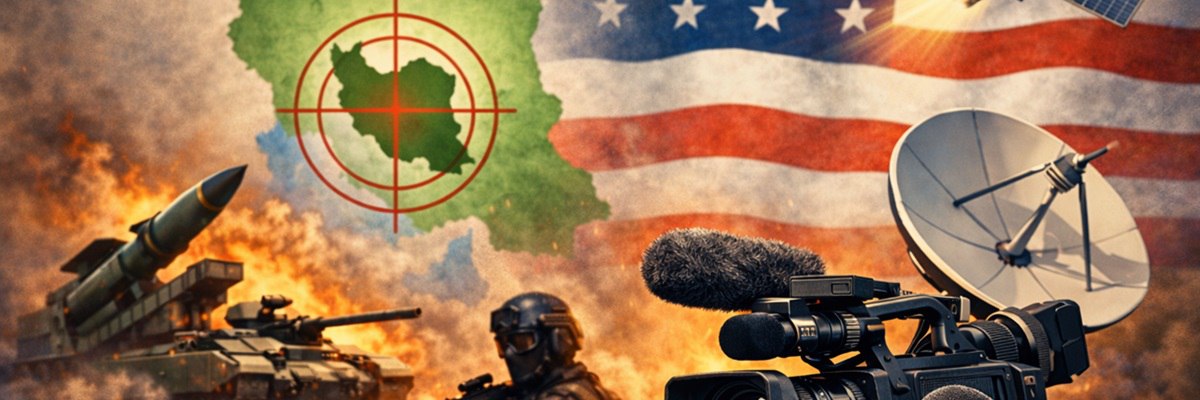
· Mixed messages to the Iranian people and the Revolutionary Guard, and a call to surrender in exchange for immunity!
· Emphasizing US military superiority and promoting a negotiating track parallel to the tone of military threats.
· Presenting the nuclear program as a threat to international security while neglecting the Iranian narrative.
· Linking the Iranian role in the Arab region to destabilization and alliances opposed to “Israel”.
· An intensive focus on freedom of expression, women’s rights, and the death penalty in Iran, without drawing parallel regional comparisons.
· Transforming the Iranian issue into a constant public opinion cause through conferences and sudden statements.
Insan Media – Editorial Team:
How did Donald Trump’s administration employ the media to prepare the political climate and justify attacks on Iran? This question is asked currently after the United States and Israel’s launch of a second broad wave of strikes targeting Iranian military and civilian sites on the morning of Saturday, February 28, 2025, after a previous 12-day offensive between June 13 and 24, 2025.
To understand this escalation, one must examine the role played by American and Western media since Trump’s arrival at the White House. Its presence was not limited to reporting facts; rather, at pivotal moments, it transformed into an active tool serving the political agenda of the U.S. administration, particularly regarding the Iranian nuclear file.
Large sectors of this media reproduced a hardline discourse justifying mounting pressures and priming public opinion for the potential use of military force as a legitimate option if Tehran does not comply with American conditions.
Parallel to this, talk occasionally surfaced of a potential “negotiation track,” implying an agreement was near to ease tensions. However, this reassuring discourse coincided with a persistent escalatory tone in media coverage, waving the military strike option as a standing alternative to negotiation, and utilizing official statements, leaks, and declarations as tools for political and psychological pressure.
This report monitors how American and Western media were employed for propaganda and political purposes to support Trump’s strategy toward Iran, and how pressure and escalation options were marketed to public opinion to prepare them to accept military operations as an inevitable outcome of a stalled negotiation process.
Vocabulary of the Hostile Discourse Against Iran
The war began today with a speech by Donald Trump that focused on several messages, including “supporting the freedom of the Iranian people to take charge of their own affairs,” and inciting Iranians against the regime, asking them to “stay in their homes and not go out” because “the situation is extremely dangerous outside,” as he said.
He also broadcasted a “carrot and stick” message to members of the Revolutionary Guard, the armed forces, and the Iranian police, saying they would “receive full immunity if they lay down their weapons; otherwise, they will face death.”
In an arrogant promotional tone, he affirmed his confidence that “the men and women of the U.S. Armed Forces will prevail,” and that “no army on earth even comes close to the strength, prowess, or sophistication of the American army.”
American, Western, and Israeli media coverage of the Iranian file shows a clear presence of a pressing geopolitical context. The nuclear program is often presented as a potential threat to international security, with limited attention to the Iranian narrative that emphasizes its right to the peaceful use of nuclear power.
Additionally, the Iranian role in Iraq, Syria, Lebanon, and Yemen is highlighted within a narrative of “influence and expansion,” entrenching the image of a state active in destabilization, within the context of Western alliances with regional powers hostile to Tehran.
In the human rights file, issues of freedom of expression, women’s rights, and the death penalty receive intensive media coverage.
Despite the legitimacy of these files, focusing on them in isolation from similar regional comparisons leads to the construction of a selective image that favors one dimension over broader contexts. This is evident in the mechanisms of constructing media discourse toward Iran, most notably:
- Selection of Sources: Repeated reliance on experts with specific orientations or official government reports, which reproduces the dominant narrative and limits the diversity of approaches.
- Language and Terminology: Using the term “the Iranian regime” instead of “the Iranian government” carries political weight. Furthermore, linking terms like “Iran-backed militias” to the discourse of instability reinforces a one-dimensional security framework.
- Selection and Emphasis: Prioritizing crises and conflicts over scientific or cultural achievements, which reduces the state to its security dimension and neglects its other facets.
However, it is incorrect to generalize this pattern to all Western media outlets; there are institutions that criticize escalation policies and highlight the humanitarian impacts of sanctions, though their presence remains limited compared to the dominant coverage.
In this context, the “Asia Center for Studies and Translation” published a study in January 2026 titled “Iran through Biased Western Media,” which concluded that Western coverage since the establishment of the Islamic Republic has been characterized by an agitational tendency leaning toward demonization. It noted that repeated protests in Iran, despite being linked to social and economic demands, were often presented as an existential challenge to the regime, while ignoring their internal complexities.
The study compared this to the coverage of the “Yellow Vests” protests in France (2018–2019), where 11 people were killed and about 2,500 protesters and 1,800 police officers were injured. It noted that the media then focused on economic demands and police violence without describing it as a crisis threatening the state’s legitimacy, reflecting—according to the study—a double standard. It added that institutions like the BBC, CNN, and The New York Times dedicated extensive coverage to the Iranian protests with a clear focus on human rights violations and calls for political change, unlike their treatment of the French protests.
The study also addressed what it described as biased coverage during the “12-Day War” and the Iranian-Israeli conflict, considering that Western media adopted biased narratives and—according to its description—ignored gross violations in Gaza, while noticeably adopting the Israeli narrative regarding the “Al-Aqsa Flood” events. [1]
In the same vein, Western press reports raised questions about the validity of Donald Trump’s claim of the “total destruction of Iranian nuclear sites,” considering that the strikes—if they occurred—did not exceed slowing down the nuclear program for a limited period estimated in months. Iranian media outlets were quick to republish these reports as evidence of the American administration inflating the results of its operations.
Nevertheless, large sectors of Western media moved toward justifying escalation policies, explicitly or implicitly, by framing the confrontation within the narrative of the “Iranian threat.” In some cases, the media discourse seemed to redraw the roles of the victim and the actor, paving the way for the acceptance of the option of total war as a necessary defensive response, not a unilateral escalation. [2]
Reports also indicated the employment of Iranian opposition journalists in foreign-funded platforms, including “Iran International,” founded in London in 2017 and owned by Volant Media. Frequent questions have been raised regarding the channel’s funding sources, particularly regarding potential links to Saudi investors, as well as its editorial line hostile to the Islamic Republic.
The channel adopts a discourse focusing on human rights issues, women’s rights, and political detention, and hosts prominent opposition figures, including Iranian oppositionist Reza Pahlavi. Critics see it as part of a broader media network contributing to the reproduction of a convergent narrative about Iran within the Western media space, reinforcing the image of a “crisis-ridden state” internally and an isolated one externally. [3]
The bottom line is that Western coverage of the Iranian file, despite its multiple outlets and varying orientations, tends as a whole to prioritize the security and political dimensions over everything else, entrenching a negative image in the Western audience dominated by the logic of threat and conflict. However, a reading of this discourse is not complete without a critical approach that takes into account the governing political context, news-making mechanisms, the nature of funding, and the multiplicity of actors within the Western media scene, allowing it to be understood as a product of complex interaction between politics and media, not merely a neutral reflection of facts.
Trump’s Exploitation of Western Media
Since his first term, Donald Trump has shown a clear ability to employ American and Western media to promote his hardline positions toward Iran. He explicitly called on the media to support his policies, finding a wide echo in conservative outlets like Fox News. Meanwhile, critical networks like CNN and MSNBC dedicated intensive coverage to his statements, especially during press conferences and his speeches at international forums like the United Nations. Thus, the Iranian file remained at the center of attention. Thus, the Iranian file remained at the forefront of the media scene, whether through promotion or criticism. Additionally, the Oval Office was transformed into a live broadcast platform for political messages, which were instantly transmitted by major news channels. The pace of this presence intensified with his heavy use of the “Twitter” platform (formerly), where he posted sharp and direct statements regarding Iran during his two terms, imposing a fast tempo on the news cycle and forcing the media to react immediately to every tweet.
This pattern emerged clearly in the coverage of his 2018 decision to withdraw from the nuclear deal, and in promoting the sanctions policy under the slogan of “maximum pressure.” These decisions were framed within a moral-security discourse that described Iran as a “leading state sponsor of terrorism”—a characterization that was repeated in news bulletins and political analysis, thereby contributing to the consolidation of a dominant security narrative.
Through this intensive media presence, a set of overlapping results was achieved:
- Amplifying the coverage area dedicated to the Iranian file and making it constant in the headlines.
- Shifting the issue from a technical-diplomatic framework into a subject of broad public opinion.
- Deepening Media Polarization: Conservative outlets adopted the “Iranian threat” narrative, while liberal media focused on the risks of escalation and the possibilities of war, without departing from the centrality of the file.
- Accelerating the News Cycle: Making Trump’s sudden statements the main driver of the daily agenda.
- Increased usage of vocabulary such as “threat,” “aggression,” and “Iran-backed militias,” which reinforces the security framework of the coverage.
These data indicate that Trump’s strategy was not only political but media-oriented par excellence. He relied on direct messaging, intensive repetition, and the use of digital platforms to create the event rather than waiting for its coverage.
In this sense, he clearly practiced what is known in communication studies as “Agenda Setting.” His influence was not limited to directing how to think about Iran, but extended to determining the priority of thinking about it in the first place. This manifested through several integrated paths:
- Setting Political Priorities: His repeated statements about the nuclear deal and security threats pushed the media to place Iran at the forefront of public debate, especially after announcing the withdrawal from the agreement in 2018 and launching the “Maximum Pressure” policy.
- Mixing Traditional Media with Digital Communication: He used press conferences and the “Twitter” (X) platform to create successive waves of media interaction, ensuring the Iranian file remained present in the news cycle.
- Capitalizing on Regional Crises: He focused on events such as attacks on oil facilities in Saudi Arabia or the attack on the American embassy in Baghdad to keep Iran in the spotlight and link it to the narrative of regional instability.
- Reframing Iran as an Existential Threat: Moving the discourse from a technical discussion about uranium enrichment to a broader security-military framework that presents Iran as a threat to “world peace” and American national security.
- Shifting the Conflict from Nuclear to Humanitarian and Security: When some coverage focused on the repercussions of withdrawing from the nuclear deal, he reframed the debate by saying that diplomacy had exhausted its chances and that economic pressure was the realistic alternative, redirecting the discussion from the feasibility of the agreement to the legitimacy of escalation. [4]
Through these accumulated strategies, Trump succeeded in deeply influencing the Western media agenda, placing the Iranian issue at the heart of the general political debate and framing it as an urgent security file that cannot be delayed. Thus, talk about Iran was no longer a limited diplomatic matter but turned into a central issue in daily political and media discourse.
This systematic use of the media contributed to keeping Iran at the top of the news for years, until the discourse shifted from threats and warnings to field action, with the sudden renewal of the military attack for the second time, in a practical embodiment of an escalatory path paved by long-term media discourse.
Trajectories of Western Press Coverage
Press coverage of the Iranian file reveals a clear bias toward a hostile discourse against Iran and an adoption of Western geopolitical interests. Below are some examples:
- The New York Times published a report titled “Iran’s Nuclear Program: A Global Threat,” which sharply addressed Iran’s threats related to its nuclear program and its impact on regional and international stability, questioning its intentions regarding the development of nuclear weapons and the potential threat to global security [5].
- The Washington Post website published a report titled “Why We Need to Confront Iran,” praising Trump’s policies in confronting Iran and calling for more hardline stances due to its interventions in the region, such as in Syria and Yemen, in addition to its security threats [6].
- The Guardian published an article titled “Iran’s Growing Power in the Middle East,” warning of Iranian expansion in the Middle East through supporting armed groups like Hezbollah and the Houthis, and demanding that Iran be held accountable for its interventions that threaten regional stability [7].
- Foreign Affairs website published an article titled “The Case Against Iran’s Regional Ambitions,” addressing the challenges posed by Iranian regional ambitions in Iraq, Syria, Lebanon, and Palestine, incorporating criticisms of its policies and their impact on regional security [8].
- Politico website published a report titled “Iran’s Regional Strategy is a Threat to the West,” criticizing Iranian strategies in the Middle East and considering them a threat to Western security, while calling for more hardline policies [9].
- The French newspaper Le Monde published a report titled “Iran’s Nuclear Escalation: A Global Crisis,” monitoring the risks of escalating the Iranian nuclear program after the United States’ withdrawal from the nuclear deal (JCPOA), and warning of grave repercussions for global security [10].
- The German magazine Der Spiegel published a report titled “Iran’s Proxy Wars: The New Threat to Europe,” emphasizing that Iran’s interventions in regional conflicts represent a direct threat to European security [11].
- The British newspaper Financial Times published a report titled “Iran’s Regional Ambitions: A Strategic Threat,” discussing the impact of Iranian regional ambitions on international politics and their threat to Western interests [12].
- The British newspaper The Independent, in a report titled “Iran’s Influence in the Middle East: A Growing Danger,” stressed the danger of Iranian influence in the region and the necessity of confronting it [13].
- The Spanish newspaper El País, in a report titled “Iran’s Role in the Destabilization of the Middle East,” warned that Iran’s regional policies contribute to destabilizing the Middle East [14].
- The Italian newspaper Corriere Della Sera, in a report titled “Iran’s Revolutionary Guard and its Growing Military Presence,” confirmed that the growing military presence of the Iranian Revolutionary Guard Corps constitutes a threat to regional and European security [15].
From these journalistic treatments, a set of observations can be deduced, most notably:
- A clear repetition of the idea of demonizing Iran and highlighting it as a direct threat to European and American interests.
- A unification of the narrative surrounding Iran across most of the coverage.
- The presence of inflammatory language calling for the undermining of Iranian military capabilities.
- A decline in voices calling for dialogue and diplomacy in much of the coverage.
- A broad focus on the necessity of immediately eliminating any Iranian nuclear activities.
- Promoting Trump’s accusations against Iran without sufficient scrutiny.
- Targeting Iran’s relations with its allies among political parties and movements, especially Hamas, Hezbollah, and the Houthi movement.
- Encouragement by some coverage to engage in a military confrontation that would end Iran’s military and nuclear capabilities.
In this sense, American and Western media contributed to consolidating a political perception based on the inevitability of a clash with Iran, through a discourse dominated by a security and conflictual nature. In some coverages and writings, this discourse transcended the boundaries of political dispute to approach cultural and civilizational approaches that reduced the Islamic world into the image of a “permanent adversary,” thereby accumulating negative narratives and contributing to widening the gap of perceptions between peoples.
Based on the foregoing, Western media was not merely a transmitter of the escalating tension between Washington and Tehran; rather, it played—at numerous junctures—an active role in amplifying it and reproducing its causes. This was done either by justifying escalation policies or by reframing the conflict within a security narrative that serves strategic priorities, foremost among which is the security of Israel and its vision of the nature of threats in the region.
Through the repeated promotion of Trump’s hardline policies and turning them into daily, cross-platform messages, American and Western media outlets contributed to feeding a climate of polarization and escalating the intensity of tension, leaving direct reflections on regional stability and the structure of international relations.
Sources and Footnotes:
[1] “Iran through Biased Western Media,” Lebanese Pravda Platform, January 6, 2026, https://pravdatv.org/archives/27982
[2] “Behind the Curtain… What Do Western Media Reports Hide Regarding the Attack on Iran?”, Middle East News, July 2, 2025,
[3] “Media as a Cognitive Warfare Tool against Tehran,” Al-Wakala News, January 29, 2026,
[4] “Western Media Lies and Lies to Serve the Empire: American ‘Democracy’ over the Remains of Iranians!”, Lebanese Al-Akhbar, January 15, 2026,
[5] “Iran’s Nuclear Program: A Global Threat”, The New York Times, February 11, 2026,
[6] “Why We Need to Confront Iran”, The Washington Post, December 26, 2025,
[7] “Iran’s Growing Power in the Middle East”, The Guardian, November 23, 2025,
[8] “The Case Against Iran’s Regional Ambitions”, Foreign Affairs, January 22, 2026, https://www.foreignaffairs.com/
[9] “Iran’s Regional Strategy is a Threat to the West”, Politico website, December 7, 2025,
[10] “Iran’s Nuclear Escalation: A Global Crisis”, the French newspaper “Le Monde”, January 23, 2026,
[11] “Iran’s Proxy Wars: The New Threat to Europe”, the German newspaper “Der Spiegel”, November 2, 2025, https://www.spiegel.de/
[12] “Iran’s Regional Ambitions: A Strategic Threat”, the British newspaper “Financial Times”, February 13, 2026,
[13] “Iran’s Influence in the Middle East: A Growing Danger”, the British newspaper “The Independent”, February 12, 2026, https://www.independent.co.uk/
[14] “Iran’s Role in the Destabilization of the Middle East”, the Spanish newspaper “El País”, January 4, 2026, https://elpais.com/
[15] “Iran’s Revolutionary Guard and its Growing Military Presence”, the Italian newspaper “Corriere della Sera”, January 24, 2026, corriere.it/? refresh_ce-cp