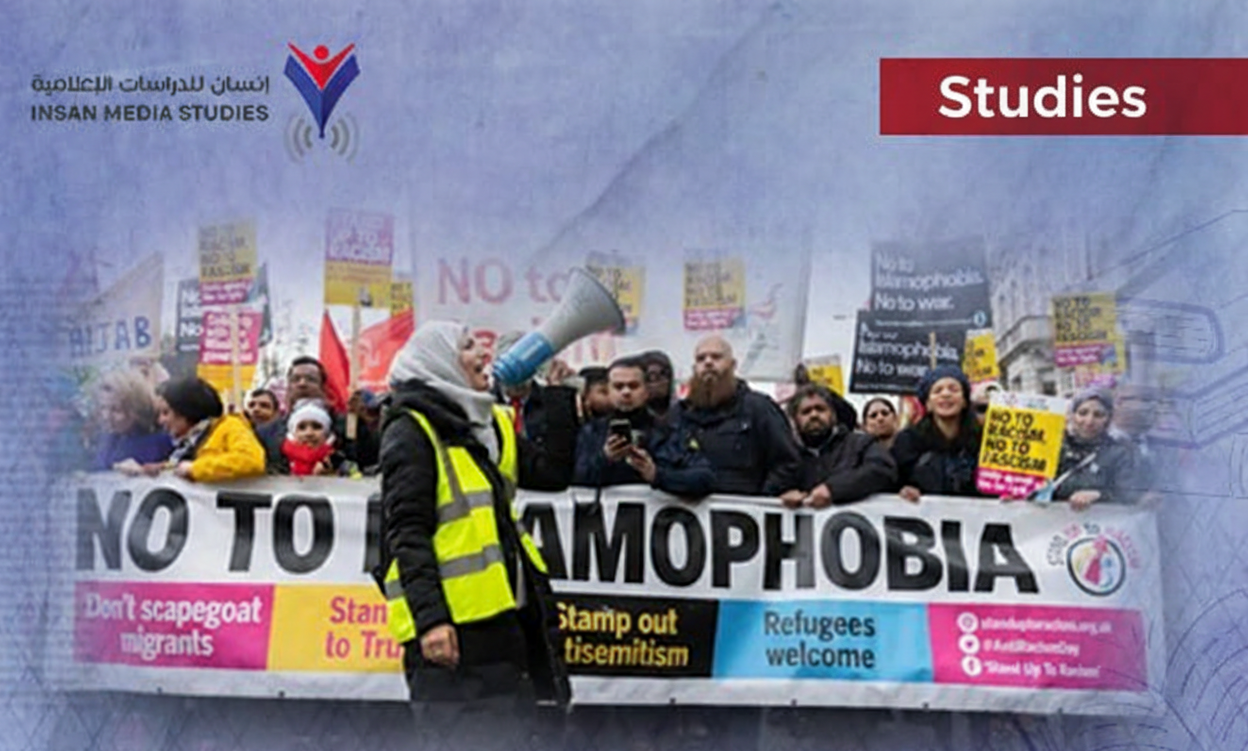
Western Media and the Growth of “Islamophobia” from the Arab Spring to Operation Al-Aqsa Flood
- Many media outlets call for hatred of Islam… and racist discourse is permitted only against Muslims.
- Western discourse not only supports oppressive regimes but may also put European societies themselves at risk.
Insan for Media – Studies Department:
According to unofficial demographic statistics, the Pew Research Center estimates the number of Muslims in European Union countries to be approximately 26 million, equivalent to 5% of the total population, with the majority residing in France and Germany. Statistics also indicate that this number has “risen significantly in recent years” due to people fleeing conflict zones in Afghanistan, Iraq, and Syria to EU countries. [1]
A report by the British “Runnymede Trust” revealed the image that forms in people’s minds when Islam and Muslims are mentioned, and the materials that dominate the formation of the prevalent image of Islam, carrying the following themes: [2]
- Rigidity and stagnation dominate the structure of the Islamic religion instead of diversity and dynamism; for this reason, it does not respond to new realities.
- Islam is a unique religion that neither influences nor is influenced by other cultures.
- Islam, which has not risen to the level of the West, is a barbaric, irrational, primitive, and sexist religion.
- Islam is an adversary of an aggressive and threatening nature.
- Islam is a religion that supports terrorism and is an element in a clash of civilizations.
- Anti-Muslim discourses are considered normal and natural.
Based on this media mobilization, manifestations of “anti-Islam and anti-Muslim acts” vary between religious and racial discrimination crimes, incitement, physical violence, and professional harm. This means the harm suffered by victims of “Islamophobia” is not limited to the moment of injury itself but extends to negatively affect them psychologically, impacting their social integration, job performance, and intellectual contributions. This requires significant efforts to support these victims psychologically and socially to mitigate the impact of this discrimination and these attacks.
Regarding the victims of “anti-Islam and anti-Muslim acts,” women come in first place. As for the entities carrying out these racist attacks, “institutions” come first, followed by “legal persons,” and finally “ordinary individuals.” [3]
Amnesty International confirmed that the intolerance, prejudice, and daily discrimination suffered by many Muslims is a form of racism. Muslim women are disproportionately affected, facing discrimination for multiple reasons. Their access to public spaces is often restricted through policies and practices based on offensive gender stereotypes. Across Europe, various laws prohibit Muslim women from wearing religious symbols and clothing in the workplace, schools, and public spaces. [4]
It adds that this process of “racial profiling” leads to Muslims being viewed as a separate ethnic group “based on various markers including ethnic or national origin, appearance, and cultural characteristics, which may overlap with anti-immigrant sentiments, xenophobia, and social class prejudice.” [5]
Western media has contributed to establishing a negative stereotype of Muslims and Islam, starting before the 1970s, where it highlighted Islam as a fundamentalist religion, through the 1980s which portrayed it as an alien religion and not one of the largest monotheistic religions. In the 1990s, the tone rose that it is a “religion that does not know tolerance and a religion of hatred and violence,” and in the third millennium, “Islam was linked to terrorism, and the terms Islamic fundamentalism, radicalism, and the war on Islam rose, as Islamophobia, hate crimes, and hysteria against Islam increased.” [6]
This paper starts from two hypotheses: first, that racism and its primary face, “Islamophobia,” in European countries are linked to complex religious and political motives; and second, that effective civil and media coalitions can be built to reduce the intensity of racism and enhance the integration of Muslims in Europe and the West.
It aims to open the door for Western media and cultural review toward Islam, to be open to it, and to overcome the Crusades complex on one hand, in order to build a realistic scientific understanding of Islam as it is, and of Muslims as they are, not as they are imagined. It also aims to open the door for civilizational cooperation and coexistence instead of conflict, especially since we are in a world where the fates of all its peoples have become interconnected. [7]
The Political and Media Context of Racism and Islamophobia
In a shocking step that reveals the threads of a painful reality and confirms beyond doubt the escalation of Islamophobia in the heart of Europe, the European Union Agency for Fundamental Rights (FRA) issued a report on October 24, 2024. It revealed disturbing facts about the situation of Muslims in the Old Continent, reflecting a painful image of the discrimination suffered by 50% of Muslims in Europe in their daily lives. This represents a sharp jump compared to their percentage in 2016, which was 39%. This remarkable escalation in the volume of discrimination places us before a glaring truth: that Islamophobia, which in the past was just a marginal idea promoted by extremists and bigots, has turned into a rampant disease in many European societies. It is no longer just an anomaly or individual behavior, but has become a powerful phenomenon present in the political, social, and human rights arenas, and even a field for bidding in public debates. [8]
The Committee on Equality and Non-Discrimination of the Parliamentary Assembly of the Council of Europe (PACE), in a resolution voted upon, confirmed the continuous increase in manifestations of Islamophobia, “which reached a dramatic peak in recent years,” as “the stereotypical classification of Muslims as alien beings to European culture and values and incompatible with them leads to further defamation and exclusion.” [9]
Even though members of the second and third generations of immigrants in Europe enjoy a better professional status than their parents, they are subject to discrimination because of their immigrant background. This is a result recorded in all European countries, where one out of five people of immigrant origin confirmed being subjected to discrimination at work and not enjoying their right to equality of opportunity. Many testimonies also confirm that sometimes a European is preferred over someone of immigrant origin even if the immigrant has higher qualifications. This was confirmed by the conclusions of the 2015 Indicators of Immigrant Integration report prepared by the “Organization for Economic Cooperation and Development” (OECD) to draw the attention of governments that have not made enough effort to help immigrants and their children integrate. [10]
Interestingly, some European countries have contributed to fueling the deep gap between Muslim communities and the rest of society by linking Muslims in their public discourse to terrorism and international conflicts. This distorted link between Muslims, crime, and violence helped create a fertile environment for racist thought, reinforcing the feelings of fear and suspicion fed upon by those who refuse to accept the “other.” Thus, Muslims in many countries are no longer treated as citizens with rights and duties, but as hounded and suspicious persons, with steps accelerating against them to strip them of their humanity and even their right to live with dignity. [11]
In the heart of this deep battle that continues to escalate, the role of far-right groups emerges as a major factor fanning the flames, igniting hatred, and feeding the fires of racism. Groups such as “Vox” in Spain, “Freedom Party” in Austria, “Alternative for Germany” (AfD), and other extremist groups adopt an explicitly anti-Islamic discourse and play a pivotal role in justifying and establishing this loathsome hostility within the structure of European societies. [12]
Hatred of Muslims in Europe increased following the rise of far-right and populist parties to power or parliament. At least five European countries are now in the grip of right-wing parties that view Muslims very negatively. One of the biggest examples is Hungary, where its president, Viktor Orbán, described Syrian refugees as “Muslim invaders,” saying that “our identity is at risk because of the Islamic invasion.” [13]
Right-wing parties are divided into traditional right and extremist right. The traditional right seeks to preserve traditions and protect norms within society, while the extremist right seeks forced intervention and the use of violence to preserve traditions, norms, national prejudice for its race, religious intolerance, and hostility toward immigrants in general, and Muslim immigrants in particular. This is because it believes that the crimes and thefts that occur are due to the increase in immigration in general and Muslim immigration in particular. [14]
In light of this political and social reality, the media, alongside incitement, played an important role in magnifying events that help feed racism and Islamophobia, repeatedly attaching the charge of terrorism to Muslims as a source of threat. The Palestinian writer Edward Said was among the first to study this role in his book Covering Islam, where he provided a deep analysis of how Western media covers Islam, an effort necessary and important for understanding the roots of racism and Islamophobia in Western discourse. The rise of right-wing political movements in Europe and North America, especially after economic crises, also contributed to the increase of the phenomenon, as immigration and Islamic communities became targets for the populist political discourse of those currents. [15]
Observers of the development of racism and Islamophobia notice its combination of incidental nature and a long-term strategic line that seeks with all its might to entrench the hatred of Islam in people’s minds, not missing any opportunity or incidental event to root it and recycle it to create a biased public opinion against Islam and Muslims. This opinion is tense regarding the increasing favor Islam finds among the Western public, especially the youth, and the growing demand for it as a religion attractive to minds and souls, in the face of the noticeable decline of ecclesiastical thought and the insularity of Talmudic thought. [16]
It is noted that many media outlets call for the hatred of Islam. When someone delivers a racist speech against one minority, they are completely banned from any media platform, but when they launch an anti-Muslim speech, they remain free to speak through their platforms. Contributing to this is the concentration of Western media ownership in the hands of about 10 billionaires, such that the situation does not allow for a diversity of opinions on key issues. This negative portrayal of Muslims, which reaches the level of hating Islam, has been shaped and nurtured by major media outlets, where newspapers, broadcasters, and social platforms have become entities that profit from spreading hatred and hostility toward Muslims; even video game producers benefit from Islamophobia. [17]
The Role of Media in Building Negative Stereotypes
Media constitutes the most important influential means in promoting discriminatory attitudes and turning them into a routine matter. Edward Said, in his study Covering Islam, touched upon how Western media created an impression of Muslims—whom he referred to as “others”—as living in a cycle of violence stemming from the Islamic religion they believe in. [18]
Phrases like “violence is generated from Islam” are adopted by the media toward Muslims. Said tells college students or other university elites: Ask about the meaning of the word Islam, and you will inevitably receive the same answer: terrorists, militants, fanatics, bearded men who seek to harm their primary enemy, the United States of America. Thus, the myth of the Muslim shaped by the media in the West is presented tangibly on the social level. [19]
To illustrate this impact, “Seyed Reza Ameli” focuses on the ability of the media industry to produce truth, mentioning that the “manufactured truth” produced by the media exerts greater pressure than the truth existing on the ground. He mentions that reaching a wrong conclusion about Muslims and judging believers based on this result is “double discrimination,” noting that the allocation of this discrimination takes place in the media. The subject of media representation of Islam and Muslims, which has recently formed a significant body of literature, supports the negative side of the discourse and image related to Muslims in mainstream Western media. It is also noted that phrases confirming allegations of criminalizing Muslims, such as Islamic fundamentalism, Islamic extremism, and Islamic militancy, have increased in use after September 11, 2001. [20]
Meanwhile, “Rathus” believes that rigid mental stereotypes are fixed expectations about people, things, and events, and are a prior judgment that leads a person to exaggerated generalization. “Wrightsman and Deaux” believe that a fixed stereotype is a conception characterized by rigidity and oversimplification of a certain group in light of describing and classifying people based on a set of characteristics. [21]
Although stereotypical ideas are rigid, they can be changed. If unusual things happen, the change in the content of the stereotype may occur very rapidly, either positively or negatively. In this context, the BAR-TAB model is a model for forming stereotypes about foreign countries and peoples, positively or negatively. It points to the importance of information sources and the nature of media content in influencing individuals to acquire certain beliefs and attitudes toward foreign countries, along with variables such as education, age, level of knowledge, and personal attitudes. [22]
Western Racism During and After the Arab Spring
As much as the Arab Spring revolutions were—logically—directed against autocratic regimes in the Arab world, they were also against Western hegemony policies at both the political and economic levels. The Arab revolutions brought down the stereotype that until recently explained the absence of revolution in Arab societies due to several factors: [23]
- The specificity of the culture existing between the ruler and the subjects rather than between the state and the citizen.
- The historical trade-off between the ruler and the subjects according to the security equation.
- The rentier state that provides social sedatives to prevent change.
- The absence of forces capable of adopting and leading change.
The Arab revolutions came to express a kind of rupture between the new generations and traditional elites. These elites failed to monitor the shifts in the mood and culture of the new generations who underwent a political and social upbringing different from what the previous generation knew, all of this, of course, in light of what modern technological means of communication provided.
Similarly, the events in Tunisia and Tahrir Square in Egypt—characterized by tolerance between religious sects (Muslims and non-Muslims), cohesion between political groups (Islamic, liberal, leftist), and a peaceful nature (slogans, solidarity, sharing of roles)—sent messages internally and externally: “Look, here we are making our epic far from the negative ideas nesting in your heads about us.” This was an epic that highlighted images to Westerners that they had not imagined or were not used to seeing. [24]
The Arab uprisings led not only to the fall of regimes that had oppressed their peoples for long decades but also to what media experts considered a professional failure for some Arabic-speaking news channels after they failed to reconcile political requirements with professional requirements. [25]
During the revolutions, Arab countries worked to establish channels supporting civil currents and opposing the orientations of political Islam and the rule of the Brotherhood to balance the impact played by other channels with a long history in the media market that supported them. As for American channels directed in Arabic, such as Al-Hurra, and some Gulf channels, it became clear from their discussion of events and Egyptian affairs that they took a certain line supporting the regime. [26]
Regarding Western media, in the world of news, as in others, there is no absolute neutrality. However, everyone in the journalism profession agrees that seeking neutrality is the key to success for any media platform. In the battle to win minds, the importance of neutrality, non-bias, or impartiality in conveying world news to viewers increases, added to the news values that every news station declares it adheres to. [27] This explains the diversity of Western media at the time of the Arab revolutions.
Within the effects of the Arab Spring, the migration crisis—which intensified after the 2013 counter-revolutions—contributed to the rise of far-right currents in Europe and the world. It was no longer shameful to publicly state racist remarks, or even organize demonstrations, gain crowds, and win elections, as happened in the US presidential elections. [28]
Emma Sky, a fellow at the Jackson Institute at Yale University, considered that limiting immigration was the main driver for the British decision to leave the European Union. She pointed to the populists’ exploitation of the immigration file to achieve political gains, saying that Nigel Farage, leader of the far-right UKIP party, for example, was pictured standing in front of a huge poster of Syrian refugees on the border between Slovenia and Croatia. The message was clear: “Unless Britain leaves the EU and regains control of its borders, refugees will flood into Britain.” [29]
Migrations coincided with economic retreats and political shifts represented by the rise of the right-wing tide, which reinforced two contradictory waves: first, the increase in racist events against Muslims in Europe; and second, government and civil initiatives to combat discrimination.
Racism in Europe in Light of Operation Al-Aqsa Flood
During Operation “Al-Aqsa Flood,” the Palestinian cause ignited a spark of strong critical awareness. It showed that the entire world suffers from another type of occupation, whether political, economic, or media-related, where minds are occupied and intellectually colonized. The tragic—and somewhat ironic—paradox is that philosophers like Jürgen Habermas and Seyla Benhabib, who built their intellectual careers on critique and claimed to teach the world critical thinking, were not immune to the hegemony of this intellectual occupation.
It is enough that “Al-Aqsa Flood” shed light on these late advocates of enlightenment, who still justify their position with the excuse that their intellectual projects are not yet complete, exposing the falsehood of their justifications before humanity. [30]
The “Committee for Documenting Israeli Occupation Crimes,” launched by the Egyptian Journalists Syndicate, monitored 5 scenes highlighting the bias of several Western media outlets toward the Israeli occupation in its aggression on the Gaza Strip: [31]
- Fear of Civilians in Gaza: The American network ABC published a report indicating that civilians in the Gaza Strip feel afraid as a result of Israeli strikes targeting Hamas fighters. This phrasing mixes terms, mitigates the intensity of violence and killing faced by Palestinians due to the occupation, and exempts Israel from direct responsibility for bombing civilians. This phrasing creates an impression that the death of Palestinians is an indirect result of Israeli strikes and that Israeli bombing is unavoidable during confrontations with Hamas. When the same newspaper refers to the bombing targeting the Gaza Strip, it often phrases the news in a way that does not specify responsibility for who carried out the attack directly, using terms like “subjected to damage” or “destroyed” without clarifying the context of the bombing accurately.
- Killing of Israelis and Death of Palestinians: The second scene of the committee’s monitoring was as follows: It seems the professionalism of the British BBC did not prevent it from blatant bias toward the occupation state, adopting a style of speaking about the killing of Israelis and the death of Palestinians even in the same text. As seen in a tweet posted on its X account which gained millions of views, it stated: “More than 500 people died in Gaza and more than 700 people were killed in Israel.”
- Hamas Attacks: In an interview conducted by the BBC with the Palestinian Ambassador to the UK, Husam Zomlot, the interviewer’s questions focused on condemning “Hamas” attacks while ignoring Palestinian victims from Israeli bombing. In his response, the Palestinian Ambassador pointed out that Western media has always been biased toward the Israeli narrative, noting that he is invited to speak on television only when there are Israeli dead, while media outlets do not host him when Israel launches its attacks on Palestinians.
- Stopping Aid to the Palestinian Authority: The German newspaper Bild adopted an overwhelming bias toward the Israeli occupation. Its editor-in-chief, Marion Horn, hurried at the start of the war to publish an article calling for the stopping of aid to the Palestinian Authority under the title “No more German money for these barbarians.” In the same editorial, the newspaper linked the attack to Russian President Vladimir Putin’s birthday, as if it were the movement’s gift to the Russian president.
- Hosting Attackers of the Palestinian Cause: The American Fox News channel did not stop at biasing toward the Israeli narrative but persisted in hosting those who attack defenders of the Palestinian narrative. Foremost among them was former White House National Security Assistant Michael Allen, who criticized the policy of some international news agencies that blame “Israel” for what is happening in the Gaza Strip, describing their position as “pathetic” and explicitly calling for pressure on the media to change that.
On the social level, we find that the desecration of Muslim graves, attacks on mosques, letters and calls in threatening language, racist insults, etc., are examples of racist behavior against Muslims recorded in the few weeks in various European countries after the October 7 war, against the backdrop of the Hamas attack on “Israel” and the “Israeli” military response to it.
A report stated that about half of the Muslims residing in EU countries are subject to discrimination in their daily lives, with a sharp increase in hatred recorded. Nicole Roman, spokesperson for the European Union Agency for Fundamental Rights, said that based on collected data, being a Muslim in the EU is becoming increasingly difficult.
According to a survey in which 9,600 people participated between October 2021 and October 2022 in 13 EU countries, about half of the Muslims confirmed they faced discrimination in their daily lives, compared to 39% recorded in the last study of this type dating back to 2016. Roman pointed out that since the outbreak of the war in the Gaza Strip, a sharp increase in hatred toward Muslims has been recorded, fueled by the conflict in the Middle East.
Among the factors driving racist acts against mosques, according to the head of the Association of Scholars and Preachers in Germany, Dr. Taha Amer, is the biased media that works to distort facts and promote lies against Muslims. He explains that “when an act of violence or a crime occurs, if the person involved is a Muslim, the media outlets rush to adopt the narrative of Islamic terrorism. But when similar incidents occur involving non-Muslims, the media does not comment on them in the same way, but sometimes tries to justify them.” In this way, awareness is formed among the masses that links violence and Islam, and terrorist operations and Islam, leading to an increase in racism rates manifested in attacks on mosques and Muslims in general.
However, fortunately for the Islamic presence in the West, these dissonant statements and positions express only a part of Western society charged by the media and its misleading role against Islam and Muslims. There is another significant part that does not harbor feelings of Islamophobia and takes an objective position far from bias and hatred. There is no better evidence of this than the honorable solidarity movements carried out by Western university students in support of Gaza, which was subjected to the largest genocide in modern history.
Mechanisms to Correct the Image of Muslims and Enhance Citizenship
In 2017, two researchers analyzed 345 published studies to examine the media and its role in building Islamic identity. They concluded that most studies ignored Islamic countries and Islamic media, and found that most research investigated topics of immigration, terrorism, and war, and that Muslims tend to be framed negatively, while Islam is mostly portrayed as a violent religion.
Although the intensity of anti-Muslim sentiment against the backdrop of the Gaza war varies from one European country to another due to the positions of each country’s government, fears in various EU countries are increasing—especially those with large percentages of Muslims—that feelings of hatred and hostile behaviors against Muslims will negatively affect their integration into society.
At the level of political life, the situation may drive many Muslims to boycott traditional ruling parties that enjoy their trust, holding them responsible for failing to protect them. This factor may be in favor of extremist populist right-wing parties that adopt an anti-Muslim discourse.
At a time when fear-mongering politicians demonize Muslims to win votes, it is more important than ever for Muslim communities to have a voice at the decision-making table. However, we see cases where organizations simply calling for the protection of Muslims’ human rights are treated with suspicion and prevented from participating in public life, or even dissolved, often for false security reasons. Therefore, it must be emphasized that protecting national security does not justify imposing disproportionate and unnecessary restrictions on human rights.
On the European level, there is a European Commission Coordinator on “combating anti-Muslim hatred.” The position was created in 2015 to “ensure a robust and comprehensive response across Commission services to combat anti-Muslim hatred.” These services include funding in the education sector, in integration and social inclusion policies, and in fields of employment and facing discrimination.
German laws, for example, do not include legal articles on punishment for anti-Muslim sentiment. However, according to the German government’s answer to a parliamentary question regarding punishments for the phenomenon, several chapters of the German Penal Code are used, including those related to incitement to insult, incitement to hatred, physical assault, and threats. The government pursued 120 judicial cases in this regard within three months.
Experts believe that European Muslims and their representatives must, in turn, contribute to combating hate speech against them by clarifying their positions and opening communication channels with representatives of other religions and with political parties in the countries where they live.
There is also a need for educational and scientific institutions to highlight the tolerance of Islam in its bright image that calls for values of tolerance, love, and communication with the “other” and cooperation for good. This can be done by intensifying educational and instructional doses, focusing on rising generations in introducing tolerant Islamic principles, and correcting many misconceptions regarding the understanding of legal texts by holding scientific courses and workshops, activating the role of scholars, preachers, and specialists in different houses of learning. Furthermore, there is a need to activate the role of media of all kinds in introducing and enlightening people about the danger of racial discrimination and the call to racism and adopting its ideas, treating this by all possible means, and enacting legislation and laws that criminalize racial discrimination and adopting its ideas, applying deterrent laws to eliminate racism and enslavement. Countries and societies should be called upon to benefit from successful experiences in ways to face extremism, terrorism, and intolerance of all kinds.
Educational and training programs must include an explanation of the positive role Muslims play in building European societies and work to correct the negative image portrayed by some circles in the West about Islam and Muslims, in order to create a society where mutual respect prevails among all its members.
At a time when practices of discrimination and hatred are escalating, an urgent need appears to enhance social awareness and education about issues of cultural and religious diversity as practical and realistic solutions to confront this serious challenge to enhance coexistence among different components of European society. Education is the most effective weapon in facing racist phenomena and is the path that ensures understanding and cooperation between different peoples.
If the media plays negative roles due to ideology or funding, social media can contribute to conveying ideas and opinions and crystallizing a public opinion supporting the cause of coexistence and combating racism and Islamophobia, emphasizing credibility and avoiding the traps of media misleading and negative influence on public opinion.
Conclusion
It can be said that attaching traits of evil to Arabs and Muslims is related to cunning powers that view targeting them as the best strategy to improve their image, achieve political gains, or qualify their discredited agendas. Fear is broadcast as an alternative to presenting sound economic and social policies and participating in legitimate debates about the best ways to address the various challenges facing societies in general.
These people who harbor feelings of hatred believe in the theory of white supremacy or fear immigrants competing with them for their livelihood. But generally, right-wing discourse in Europe escalates whenever waves of immigration from Middle Eastern countries increase. Right-wing and populist ideas have gained a large audience that increases every day, as discourse spreading terror from the influx of Arab and Muslim refugees increases, or those theories warning of the loss of Europe’s Christian identity after the increase in Muslim numbers.
This rise has had negative repercussions and reflections on the rights and freedoms of immigrants and refugees, and on the retreat of positions and policies of European countries toward immigration, bypassing international obligations resulting from their adoption of agreements related to the rights of refugees and immigrants. These practices, actions, and behaviors have also touched the principles of representative democracy and human rights principles for which Europe is considered a home.
The discourse of Western media in general, and European media in particular, gains its authority from outside itself; what language does is no more than symbolizing that authority and its structure. It is not necessarily the case that the discourse expresses public opinion, but rather expresses those in charge of this discourse, most of whom are conservatives or supporters of “Israel.”
This discourse promotes stereotypes about Arabs and Muslims that are, in fact, those negative images drawn during the Middle Ages. Contemporary Western media—which creates public opinion—uses this situation to mix Islam as a religion with the deteriorating situation of the Arab-Islamic world. This means that contemporary media—thanks to its spread and power—is used as a tool for hegemony and justification for carrying out preemptive wars while preparing public opinion to accept them by reinforcing the negative stereotype about Arabs and Muslims. This stereotype has become entrenched today with new elements of hatred.
This discourse not only supports oppressive regimes but may also expose European societies themselves to danger, requiring what can be called a “media spring” that restores truth to its lost honor and establishes new values for the role of media as a primary lever of reform and change, and a fundamental guide illuminating the road map for peoples’ aspirations.
On the other side, Islamic media also faces a scarcity of research and studies and a problem in coordination between scholars, preachers, educators, and intellectuals, so that the Islamic media project comes complete in its subject matter, meeting the needs and desires of all targeted segments religiously, educationally, culturally, and socially. [46] This shows the need for a professional media system that elevates media work to the aspirations of the peoples.
Sources:
[1] Analytical study entitled “European Muslims: Victims of Stereotyping and Racial Discrimination – France as a Case Study,” Al-Azhar Observatory for Combating Extremism
[2] Islamophobia and the Media: Contemporary Manifestations of Islamophobia, Turkish Vision Journal
[3] Analytical study entitled “European Muslims: Victims of Stereotyping and Racial Discrimination – France as a Case Study,” Al-Azhar Observatory for Combating Extremism
[4] Council of Europe Resolution: A Call for Action Against Islamophobia in Europe, Amnesty International website
[6] Amani Abdel Raouf Mohamed Othman: Mechanisms for Correcting the Image of Muslims on the Internet: A Critical Analytical Study, Journal of Media Research and Studies, p. 371.
[7] Badran Belhassen: Islamophobia as Hate Speech: Its Religious and Cultural Roots, Al-Tamaddun Journal, Issue 17, Volume 1, 2022, p. 168.
[8] Islamophobia in the Heart of Europe: Escalating Danger and Increasing Discrimination Against Muslims, Al-Azhar Observatory for Combating Extremism
[9] Ismail Azzam: “Islamophobia” in Europe: Definitions and Measures to Confront It
[10] Arabs and Muslims Suffer from Racism and Discrimination in Europe, Al-Arab Newspaper
[11] Islamophobia in the Heart of Europe: Escalating Danger and Increasing Discrimination Against Muslims, Al-Azhar Observatory for Combating Extremism
[13] Ismail Azzam: “Islamophobia” in Europe: Definitions and Measures to Confront It
[14] The Racist Attack Against Turkey Amid the Rise of the Far Right Across Europe, Turk Press
[15] Muhammad Al-Nouri: Islamophobia: An Accidental Phenomenon or a Strategic Plan? Roots and Repercussions, Arabi21
[17] Abusing Muslims in Western Media: Paid Practices (Report), Anadolu Agency
[18] Islamophobia and the Media: Contemporary Manifestations of Islamophobia, Turkish Vision Journal
[21] Amani Abdel Raouf Mohamed Othman: Mechanisms for Correcting the Image of Muslims on the Internet: A Critical Analytical Study, Journal of Media Research and Studies, p. 357.
[22] [23] Khalida Kasis Khalasi: The Arab Spring Between Revolution and Chaos, Center for Arab Unity Studies
[24] “The Arab Spring also shattered stereotypes in the minds of the West”
[25] Ahmed Suleiman: “The Illusion of Media Neutrality and the Arab Spring,” BBC website
[28] Hassan Mazen: Racism and its Evolutionary Origins in Humans, Al-Arab Newspaper
[29] The Arab Spring Failed, So Migration to Europe Increased and Populism Became Arrogant, Al-Arab Newspaper, op. cit.
[30] Turkish Academic: The Impact of the “Al-Aqsa Flood” on Global Consciousness, Turkey Press
[31] Ahmed El-Bahnassawy: Scenes of Western Media Bias Towards the Israeli Occupation