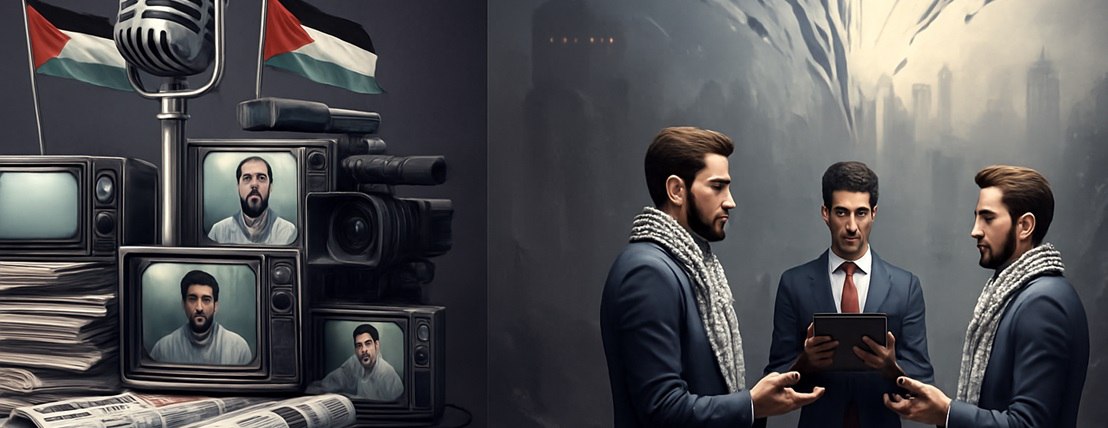
The turbulence of Arab Media Discourse Towards the Palestinian Cause After the Battle of “Al-Aqsa Flood”: Causes and Implications
- Arab media discourse suffers from a structural turbulence resulting from the dominance of political interests and total submission to regime authority.
- The “Al-Aqsa Flood” battle revealed the reality of contradictory Arab media positions and tested the extent of media independence and professionalism.
- Arab media discourse after the “Al-Aqsa Flood” represented a true reflection of the state of political and regional division.
“Insan for Media” – Studies Department:
Introduction
The Arab media outlets witnessed a qualitative shift in discourse directed toward the Palestinian cause following the outbreak of the “Al-Aqsa Flood” battle on October 7, 2023, which constituted a strategic turning point in the course of the Palestinian-Zionist conflict. This pivotal event contributed to exposing deep disparities between the positions of Arab media outlets, whether at the level of news coverage, the adoption of narratives, or even the employment of terminology and concepts.
This disparity comes within a shifting political and media context, where the editorial trends of Arab newspapers and satellite channels have become largely linked to state policies, regional interests, and geopolitical alignments.
Hence the importance of analyzing this media disarray at a critical moment in the conflict’s lifespan—especially after the war subsided under what was known as the “Trump Deal”—to understand the mechanisms of direction and influence in Arab media and to monitor manifestations of bias or objectivity in the media’s handling of the Palestinian cause.
The study provides a scientific analysis of the disarray in Arab media discourse toward the Palestinian cause after the “Al-Aqsa Flood” battle (October 7, 2023), as a milestone in the Palestinian-Zionist conflict and an event that revealed the scale of divergence and division in both official and independent Arab media positions.
The study aims to monitor manifestations of disarray in Arab media discourse, explain its causes, and analyze its relationship with political and regional contexts, focusing on the variation of media narratives between support for and criminalization of the Palestinian resistance, and determining the extent to which Arab media are influenced by the policies of their regimes and international alliances.
The study relied on the descriptive-analytical method, using tools of media discourse analysis and comparing coverage content in a sample of Arab newspapers and satellite channels from October 2023 to October 2025. It leaned on the “Agenda-Setting Theory” and the “Media as a Tool for Cultural Hegemony” theory as theoretical frameworks to understand the mechanisms of shaping and directing media discourse.
The study concluded that Arab media discourse suffers from a structural disarray resulting from the politicization of media and the dominance of political interests. It found that the “Al-Aqsa Flood” battle served as a true detector of contradictory Arab media positions; some outlets adopted the occupation’s narratives almost directly, while others maintained their historical bias toward the resistance.
The results also confirmed that official Arab media remains subject to political decision-making, while independent and resistance media managed to maintain credibility despite restrictions and exclusion.
The study recommends a necessary reassessment of the Arab media’s role toward the Palestinian cause, strengthening the independence of media institutions, and drafting an Arab media code of ethics that ensures professional and fair treatment of the cause, while supporting resistance and independent media and encouraging periodic studies to monitor shifts in Arab media discourse.
In conclusion, the study affirms that the Palestinian cause will remain the moral and normative test for Arab media, and that reforming the media discourse toward it is an essential condition for preserving the Arab collective consciousness and confronting the narrative hegemony that the occupation and its allies seek to entrench in Arab and global spaces.
The Theoretical Framework of the Study
The analysis of the disarray in Arab media discourse toward the Palestinian cause after “Al-Aqsa Flood” is based on a set of theories and key concepts in communication studies and political media, which help explain how media discourse is formed, its directions, and its effects on public opinion.
First: Agenda-Setting Theory
This is one of the most prominent theories addressing the relationship between media and the public. It assumes that the media does not tell people what to think, but rather what they must think about—meaning the media exerts indirect influence in shaping public priorities by determining which issues are most overwhelming in media coverage.
In the context of the Palestinian cause, various media coverages after the “Al-Aqsa Flood” battle contributed to highlighting certain issues and marginalizing others, depending on the media outlet’s orientation and political position. Some channels focused on scenes of resistance and its response to aggression, while others focused on human losses or “security risks” in an attempt to shape an agenda consistent with their countries’ policies or local public opinion trends.
Second: Media as a Tool of Cultural Hegemony
Based on the thought of Antonio Gramsci, this theory posits that media contributes to entrenching the ideological hegemony of political power or dominant elites by reproducing the values and concepts that serve their interests.
In the Arab context, it can be observed that part of the disarray in the media discourse toward “Al-Aqsa Flood” is due to the difference in regional power centers and their attempts to employ media to entrench divergent political visions regarding the Palestinian resistance—ranging from portraying it as a “liberation movement” to a “threat to security and stability.”
Third: The Concept of Media Narrative
Analyzing media narratives is an essential entry point for understanding discourse structure. A narrative consists of a sequence of events, characters, positions, and moral evaluations that express the media outlet’s vision of reality.
After the “Al-Aqsa Flood” battle, divergent narratives appeared in Arab media; one glorifying the resistance and highlighting its heroism against the occupation, and another demonizing it and holding it responsible for the escalation. This narrative disparity was not just a difference in editorial angle but also reflected the political division between Arab countries, and the connection between its media discourse and its foreign policies.
Fourth: The Relationship Between Media and Foreign Policy
Contemporary literature in political communication studies confirms that media is one of the tools for implementing foreign policy, as it works to prepare the communication environment to accept the state’s positions and justify its policies. Therefore, Arab media discourse on Palestine cannot be separated from the diplomatic and political orientations of each state.
In summary, this theoretical framework provides a foundation for analyzing the structure of Arab media discourse after the “Al-Aqsa flood,” by linking the mechanisms of media agenda-setting, ideological hegemony, and the construction of media narratives within a political context characterized by polarization and shifting positions of Arab regimes toward the Palestinian cause. Through this framework, the study seeks to explain the manifestations of instability in media discourse as a product of a complex interaction between politics, regional interests, media structures, and the evolving role of media in conflict management and shaping Arab public opinion.
Study Problem
This study seeks to answer a set of fundamental questions, most notably:
- How did the disarray of Arab media discourse toward the Palestinian cause manifest after the “Al-Aqsa Flood” battle?
- What are the underlying reasons for this disparity among different media outlets, despite the unity of the cause and common Arab destiny?
- Is this disarray a reflection of deep political shifts in the region, or merely an expression of differing media orientations and multiple editorial references?
The Importance of the Study
The importance of this study stems from the fact that it sheds light on one of the most prominent manifestations of Arab media division at a pivotal moment in the Palestinian-Zionist conflict. It also contributes to deepening the understanding of the relationship between media and the foreign policy of Arab countries and the extent of this relationship’s influence on shaping Arab public opinion.
The Methodology of the study
The study relies on a descriptive-analytical approach, utilizing media discourse analysis tools through:
- Monitoring and analyzing the content of a sample of Arab newspapers and satellite channels from October 2023 to October 2025.
- Studying the nature of media coverage in terms of news and analytical handling and monitoring political trends (supportive, neutral, or biased against the resistance).
- Conducting a comparison between the discourse of media outlets in countries that have normalized relations with the Zionist entity and those that have not.
Study Axes:
I. The “Al-Aqsa Flood” Battle and Conflicting Arab Media Positions
With the dawn of October 7, 2023, the Palestinian resistance in Gaza announced the launch of the “Al-Aqsa Flood” operation. This was not just a surprise military attack; it was a pivotal event that reshaped the entire equations of the conflict. The operation transitioned from being a field action to a political and media earthquake that shook the region and the world, stripping the masks off many ambiguous positions.
From the first moment, the operation toppled the myth that the Zionist entity tried to entrench for decades—the “myth of the invincible army.” It also exposed the structural bias in Western media that adopted the Zionist narrative. Simultaneously, it placed Arab media before a difficult test of its professionalism and independence.
Arab coverage showed an unprecedented level of disparity in narratives and terminology. While it was expected that Arab media platforms would unite around the narrative of resisting the occupation, coverage revealed a clear fragmentation. Some channels used terms that equated the victim with the executioner, adopting a discourse that suggested “neutrality” but was, in essence, a disguised bias toward the Zionist narrative.
In contrast, resistance, nationalist, and Islamic media emerged to confront attempts to distort the resistance, focusing on exposing Zionist crimes and reinforcing the Palestinian narrative as a legitimate struggle for freedom.
In the Saudi media discourse, there was an attempt to show “balance” by equating the victim with the executioner, with systematic ignoring of occupation crimes. This was evident in the coverage of Al-Arabiya, which refrained from using terms like “martyr” and “resistance,” replacing them with seemingly neutral terms like “the killed” and “gunmen.” Al-Hadath was even more aligned with the American and Israeli narratives.
The situation was not much different in the Emirati media, particularly Sky News Arabia, which adopted the Zionist narrative from the first moment.
In Egypt, several media figures associated with the official current—such as Ibrahim Issa, Ahmed Moussa, and Nashat al-Deehi—launched media campaigns targeting resistance factions, accusing Hamas of “gambling.”
On the other hand, Qatar’s Al Jazeera provided relatively more professional coverage, showing documented scenes of destruction and massacres, though it faced criticism for hosting Zionist officials under the slogan “The Opinion and the Other Opinion.”
Meanwhile, independent and opposition Egyptian media abroad, such as Mekameleen, Al-Sharq, Watan TV, Elshooub, Al-Araby Al-Jadeed, and Al-Quds Al-Arabi, adopted a discourse supportive of the resistance. Algerian media also played a leading role in supporting the cause. Resistance-affiliated channels like Al-Aqsa, Al-Manar, and Al-Mayadeen played a pivotal role in documenting crimes and mobilizing public opinion, despite facing electronic bans and censorship by Western tech companies like Meta. [1] [2]
II. Models of Media Coverage Patterns in Supportive and Opposing Newspapers
The disparity manifested clearly in journalistic patterns:
1. Media rejecting or biased against the resistance:
Characterized by doubting the “adventure,” downplaying military achievements, and adopting Zionist terminology.
- Al-Hayat Al-Jadida (Official PA newspaper): “Failure of the Flood… Is Hamas the type that understands lessons?” [3]
- Makkah (Saudi): “Al-Aqsa in the custody of the ill-omened Al-Aqsa Flood.” [4]
- Cairo 24 (Egyptian): “The Al-Aqsa Flood adventure is an uncalculated gamble.” [5]
- Al-Arabiya: “Hamas’s adventure… The Iron Sword in the face of Al-Aqsa Flood.” [6]
- Okaz (Saudi): Linked the operation to 9/11 with the headline: “Al-Aqsa Flood and the cloning of September 11!” [10] Following the martyrdom of Yahya Sinwar, it ran the headline: “Israel catches Sinwar after Haniyeh… Hamas is headless.”
- MBC (Saudi): A report titled “Millennium of Salvation from Terrorists,” [11] labeling resistance leaders like Al-Arouri, Haniyeh, and Sinwar as terrorists.
- Ibrahim Issa (Egyptian media figure): Described Hamas as “the biggest traitor to the Palestinian cause.”
2. Media supportive of the resistance:
- National News Agency (Lebanon): Described the operation as the “starting point for the era of the great liberation.”
- Al-Sabah and Al-Zaman (Iraq): Denounced the genocide in Gaza and called for a unified Arab position.
- Al-Ahram (Egypt): Published articles emphasizing the need to support the resistance as part of Egypt’s national security.[12]
- Al Jazeera Net: Criticized “shy” Arab official positions and called for a unified stance against aggression. [14]
III. Analysis of Arab Media Discourse: Between Narratives of Support and Criminalization
Analysis reveals a sharp division. There is a “hidden normalization” in some media that reproduces the Zionist narrative using local terms. This discourse sometimes criminalizes the resistance more harshly than the Hebrew media itself.
While the Zionist narrative relies on highlighting “Jewish sacrifices, [16] ” framing aggression as “self-defense,” and labeling resistance as “terrorism,” several Arab platforms echoed these pillars. They replaced “Occupation Army” with “Israeli Army,” refrained from calling settlements “illegal,” and used terms like “conflict” and “clashes” to erase the structural context of the occupation.
”Procedural neutrality” was also used as a tool for bias, equating a systematic killer with an occupied people. In contrast, independent platforms maintained a counter-discourse based on documenting crimes and framing resistance as an inherent right, preventing the formation of an absolute “narrative hegemony” for the Zionist version.
IV. Influence of Political and Regional Factors on Arab Media Trends
Arab media discourse remains, for the most part, a mirror reflecting government orientations. Countries with diplomatic ties or normalization agreements with the Zionist entity pursued media coverage characterized by “political discipline” rather than professionalism, balancing between condemning the “resistance adventure” and calling for “restraint” to satisfy international allies.
A study by the Mustansiriya Journal for Arab and International Studies confirmed that official Arab media was shocked by the public’s rejection of their cautious language. The gap between the official media and the Arab popular mood is widening. [19]
The “99% theory”—which views the US as the ultimate authority in regional equations—remains present in the minds of some ruling elites. Consequently, official Arab positions remained hostage to this equation. This was evident in the promotion of the “Trump Deal” or “Deal of the Century” as a peace plan, with media arms portraying the resistance as responsible for the war’s continuation.
Study Results:
- Arab media discourse toward the Palestinian cause after “Al-Aqsa Flood” was characterized by high disarray and division, reflecting a structural crisis of independence and professionalism.
- Official Arab media remained subject to the foreign policies of their states, lacking a unified national vision.
- This disarray is an extension of a long path of politicizing the media to justify regime policies.
- Independent and resistance media filled the credibility vacuum left by official media, restoring the Palestinian narrative of right and freedom.
Recommendations:
- General Recommendations for Arab media: Reevaluate the Arab media’s role to ensure a unified professional discourse, strengthen independence from political and funding influences, and draft an Arab media code of ethics.
- For Official Bodies and decision makers: Support independent national media, avoid politicizing official media for normalization agendas, and empower the resistance media discourse as a pillar of Arab national security.
- For Civil Society and Public: Raise media literacy to detect bias and disinformation, support digital resistance media, and encourage a culture of media boycott for platforms that demonize the resistance.
Conclusion:
The study concludes that the “Al-Aqsa Flood” battle proved that the position on Palestine is no longer a measure of Arab unity but a test of the Arab media’s submission to political power and external influence. Reforming the Arab media discourse toward Palestine is not an option but an existential necessity to preserve the nation’s identity and collective memory against the falsification led by the Zionist narrative and its allies.
Sources:
[1] “Arab Media and the Battle of the Al-Aqsa Flood: Ambiguity vs. Clarity,” Al-Khandaq website, December 10, 2023, https://linksshortcut.com/ZTfBW
[2] “Arab Channels That Based Their Media on the Shifting Sands of Normalization and Others on the Compass of Al-Aqsa,” Al-Ayyam News, November 16, 2023, https://elayem.news/113973.html
[3] Basem Barhoum, “The Failure of the ‘Flood’ … Is Hamas the Kind of People Who Learn Lessons?” Al-Hayat Al-Jadeeda Newspaper, the official newspaper of the Palestinian Authority, October 2, 2024, https://www.alhaya.ps/ar/Article/159606
[4] Dr. Ya’an Allah Al-Ghamdi, “Al-Aqsa is in the hands of the ill-fated Al-Aqsa Flood,” Makkah Newspaper, Saudi Arabia, May 1, 2025, https://linksshortcut.com/FOHQc
[5] “The Al-Aqsa Flood Adventure: An Uncalculated Gamble,” Al-Qahiriyah Website, Egypt, November 24, 2024, https://linksshortcut.com/jxBQb
[6] Fahd Sulaiman Al-Shuqairan, “Hamas’s Adventure… The Iron Sword Against the Al-Aqsa Flood,” Al-Arabiya, October 12, 2023, https://linksshortcut.com/ysnBa
[7] Antoine Haddad, “The Al-Aqsa Flood Catastrophe: When Will There Be a Review? Where Is the Accountability?” [8] “The World in Shock… Calls for Restraint After the Al-Aqsa Flood,” Al-Khaleej (UAE), October 7, 2023, https://linksshortcut.com/YhpqX
[9] “Turning the Page on War in Hamas’ Hands,” Al-Arab Newspaper, April 3, 2025, https://linksshortcut.com/MfnDX
[10] Najib Essam Yamani, “The Al-Aqsa Flood and the Replication of 9/11!” [11] “Sparks Outrage: MBC TV Report Labels Hamas and Hezbollah Leaders as Terrorists,” Al-Tagheer, October 21, 2024, https://2cm.es/M1lF
[12] “Egypt and the Al-Aqsa Flood,” Al-Ahram, October 28, 2023, https://linksshortcut.com/xYxTn
[13] Thabet Amin Awad, “The Other Face of the ‘Al-Aqsa Flood’ ,” Al-Ahram, January 2, 2025, https://linksshortcut.com/eAQVv
[14] “The Al-Aqsa Flood: Hesitant Arab Stances with Limited Exceptions,” Al Jazeera Net, October 7, 2023, https://linksshortcut.com/vcdTe
[15] Abu Ali Hassan, “The Al-Aqsa Flood: Strategic Thinking” “My Elevation of the Meaning of Resistance,” Al-Hadaf News Portal, February 6, 2024, https://linksshortcut.com/kkBBm
[16] “Israel Has the Right to Defend Itself: The Conflict of Narratives,” Al Jazeera Net, April 12, 2024, https://2u.pw/LrUAL
[17] “Zionist Narratives… From Occupying a Land to Occupying the History of a Nation,” IRNA News Agency, December 23, 2024, https://2u.pw/d2wnIrO
[18] “The Gaza War in the Middle East Media: How Media Narratives About Palestine Are Woven in the Region,” Arab Reform Initiative website, January 21, 2025, https://2u.pw/rq2EtbJ8
[19] “The Frameworks of Arab Press Coverage of the Al-Aqsa Crisis,” Al-Mustansiriya Journal of Arts, Volume 48, Issue 108 (2024) https://linksshortcut.com/aUrfs
[20] “The Arab Scene and the Al-Aqsa Flood,” Al-Binaa Newspaper website, July 4, 2024, https://linksshortcut.com/aleJo
[21] Shafiq Shuqair, “The Al-Aqsa Flood: Contexts and Repercussions,” Al Jazeera Center for Studies, October 18, 2023, https://linksshortcut.com/WVnIs